• original public meaning

    One of my side projects in 2026 has been to record brief audio essays about the rich histories of English words, particularly as they emerge from their Greek and Roman ancestors, for a new podcast called Original Public Meaning. I was inspired to create these recordings, at least in part, by how much I enjoyed producing a similar audio essay on the Latin verb proficio for the Thesaurus Linguae Latinae in 2025. And cultural-criticism-via-word-history has been a favorite beat of mine for many years.

    I’ve been recording two episodes of this show per week. A few of my favorites are listed below.


    nostalgia” defined as a longing for one’s home, one’s past, and one’s own psychological space:


    convention” considered both as a meeting place and as a prevailing social practice:


    incandescent” viewed through the lenses of technological and moral development:


    I’m also realizing how effective audio recordings can be for teaching: producing brief segments to reflect on a section of the Iliad that didn’t quite make it into lectures, for instance. Making these kinds of recordings for students is more knack than science, so the podcast is a good opportunity for practicing all kinds of skills: microphone technique, argumentative clarity, and refining prose for the ear rather than the eye.

    You can find all the episodes at the show’s website. (And no, the podcast has nothing to do with originalism as a legal theory; Original Public Meaning is just a good title for a show about the complex histories of words.)

  • a century’s quarter note

    freedom art quartet // faqmusic.com

    Freedom Art Quartet — First Dance

    In the album notes for First Dance, the Freedom Art Quartet says their “purpose is to explore … the limitless dimensions of the art form.” Sign me up, folks. Right out of the gate, “Counterbalance” explodes into energetic interplay, hurtling toward chaotic culmination and eventual dust-settling. “Song for the Old Ones,” a twelve-minute almost-ballad, never drones and never spins out, in large part thanks to masterful drumming. Even with its formalist devotion, First Dance isn’t some exercise in tired, mid-century nostalgia: “Nature of the Past” foregrounds sonic and instrumental expansiveness that you might well find on some new post-rock album.

    Nicole McCabe — A Song to Sing

    This release is one of many produced by a constellation of jazz musicians in Los Angeles this year. Nicole McCabe, a young saxophonist, combines her own instrumental talent with bold, even lush production. Sometimes it feels like you’re listening to Homogenic but with a saxophonist taking the place of Björk’s improvisational vocals. Elsewhere, tracks like “San Benito” present McCabe through the lens of a kind of baroque pop. Her co-producer Pete Min released his own album this year (alongside Joey Waronker) with some great stuff, on which Tortoise’s Jeff Parker occasionally plays. (Tortoise had their own worthwhile release this year.) Parker has been around for years, but these other associated musicians are also worth watching.

    Joanna Mallwitz and Konzerthausorchester Berlin — The Kurt Weill Album

    There’s more Kurt Weill out there than just The Threepenny Opera. This recording opens with the gripping, dissonant chords of Weill’s 1921 Berliner Sinfonie, a work that never rests even in its Andante religioso. Another collaboration between Weill and Bertolt Brecht—a scored ballet on the seven deadly sins (Die sieben Todsünden)—occupies the album’s middle section. I have found it interesting not just to look for translations of its sharply satirical libretto (“He who does no wrong will atone for it on earth,” for instance) but also to read accounts of the work, whose listeners “start by laughing and then discover in their laughter a certain pain.” (Other superb classical releases this year include the music of Bohuslav Martinů and Tarquinio Merula.)

    The Kasambwe Brothers (self-titled)

    Hailing from Rwanda and recording the first release for a new label out of MASS MoCA, the Kasambwe Brothers sing over instruments of their own making: sometimes developing a melody over repeated strumming, sometimes ceding the floor to their guitars and percussion. Listening to this album reminds me of sitting in the back seat while the worn cassette of Paul Simon’s The Rhythm of the Saints plays for the fourth time in a row. Amid so many global crises, this joyous release—its ecstatic hollers, its rhythmic heartbeat—reminds listeners that there is still a world of brotherhood out there.

    Ryan Davis and the Roadhouse Band — New Threats from the Soul

    I’m hardly the only person to praise this bundle of poetic, winding alt-country (or “punked-up country gunk“). Ryan Davis’s new album sounds like some hybrid of Wilco and Lucinda Williams, combining genre-bending production with the hyper-local backdrop of pawn shops and small-town bars. One track can’t “tell the cattle roads from the chemtrails of our past lives”; another track documents how “Dionysus hits the urinal.” It’s an album that falls just on the right side of the boundary between allusiveness and inscrutability—like modernist literature recited on a Great Plains radio station. Its dense, almost-enigmatic lyricism is part of the reward of repeated listening. Davis asks, “Are we getting any closer to me knowing what the point of this is?”—well, not really, thank goodness.

  • the gladiator & the gadfly

    In a brief essay for the latest issue of Commonweal, I consider the aftermath of the murder of Charlie Kirk and make the case that “robust discourse” in academic settings can never be entrusted to political pundits. Instead, colleges and universities need to defend “substantive principles like toleration, moral freedom, and openness to doubt,” and doing so will require institutional recommitment to teaching advanced literacy and the “slow-paced rituals of humanistic learning”:

    In my view, colleges and universities already have monuments to “open, robust discourse.” They’re called libraries. In their quiet stacks, one can find John Rawls’s A Theory of Justice not far from Robert Nozick’slibertarian response, Anarchy, State, and Utopia. Library patrons can read Frantz Fanon’s defense of political violence in The Wretched of the Earth, but they can also pick up a copy of Hannah Arendt’s On Violence, her rejection of bloodshed in the pursuit of political power. Spirited disagreement can be found on every American campus. We simply need to pull it off the shelf.

    I realize how naïve this may seem amid the chorus of articles reporting that college students can’t read selections from demanding books, let alone entire volumes. Even so, colleges must promote their own literate vision of “robust discourse” and hold firm to their identity and mission against opportunistic political actors. They make a grave, self-destructive error if they accept that intellectual life is best represented by a tent emblazoned with the insincere taunt “Prove Me Wrong.”

    This essay picks up on some ideas that I considered years ago in a review of Zena Hitz’s book Lost in Thought—that review remains one of my favorite contributions to Commonweal. On a related note, I was happy to be consulted alongside Hitz and others for a report in The Guardian on the state of humanities education at US universities.

  • saint augustine on posting

    “The sin of the sophist is that he denies the necessity of subject matter and believes that forma alone is desirable. An opposite vice, one to which historians of rhetoric have never given a name, depends upon the belief that the man possessed of truth will ipso facto be able to communicate the truth to others. It is a dependence upon materia alone. Its chief proponent in ancient times was the young Plato, and it would seem fair to label it the “Platonic rhetorical heresy” just as we apply the term “sophistry” to its opposite theory. This is not to say that the ecclesiastical writers of the fourth century looked to the Gorgias and Protagoras for a theory of communication, but rather that their reactions to the pagan culture of Rome led many of them to take up a somewhat similar attitude toward the rhetoric which was a part of that culture. Augustine apparently recognized a danger in this aspect of the cultural debate of his times, and used the De Doctrina [Christiana’s fourth book] to urge a union of both matter and form in Christian preaching.

    Only if one views the book as part of the great debate of the fourth century, therefore, does its historical importance emerge clearly. The reader is struck by the author’s insistence upon the folly of abandoning a useful tool to the enemy.”

    —James J. Murphy, “The Debate about a Christian Rhetoric,” in The Rhetoric of St. Augustine of Hippo, eds. Enos, Thompson, et al. (2008)

  • ut silvae foliis: proficio and progress


    I recently recorded a podcast episode for Ut Silvae Foliis, a series of reflections on Latin words as documented in the Thesaurus Linguae Latinae, the world’s foremost Latin dictionary. While a postdoctoral fellow at the TLL in 2016/2017, I had the great fortune to learn about an inexhaustible diversity of Latin authors, and this 15-minute audio essay was a welcome opportunity to revisit the Thesaurus and its sources.

    I chose to discuss the verb proficio, perhaps best translated in English as “to progress” or “to improve.” Over the course of a millennium, this verb appears in an almost-overwhelming array of texts, all of which raise provocative issues about our own notions of “improvement.” What does it mean to “be better” or to “become better”? What does it mean for someone or something to “progress”? These are difficult questions that straddle the domains of lexicography and intellectual history. Even if the TLL can’t settle a perennial problem like the definition of “progress,” it can nevertheless give us a glimpse at how our predecessors have wrestled with these intractable matters.

  • a banquet for the birds

    I’ve admired the music of both Aaron Diehl and Darcy James Argue for years—the former as an inheritor of and innovator in the tradition of pianists like John Lewis and Mary Lou Williams, the latter as a composer and bandleader whose works stretch the idiom of American big band in cerebral directions while augmenting its musicality. Fantastic stuff all around.

    This past weekend, Diehl (who took over the 92Y “Jazz in July” series from Bill Charlap last year) hosted Argue and his band for the final night of the concert series. After performances of some of their earlier works, they premiered Argue’s new three-movement suite “A Banquet for the Birds.” (Major thanks to the 92Y for continuing to sell digital access to concerts, even years after the worst of 2020’s ambulance sirens. I was so happy to be able to watch while on a trip to rural Michigan.) This new work draws inspiration from Emily Wilson’s recent translation of Homer’s Iliad (which I haven’t read yet), and Argue’s title comes from one of its opening lines, which recounts how the Trojan War “made men the spoils of dogs, a banquet for the birds” (αὐτοὺς δὲ ἑλώρια τεῦχε κύνεσσιν / οἰωνοῖσί τε πᾶσι).

    The first movement (“The Sparrows and the Snake”) begins with a continuo organ, quickly giving way to trumpet flourishes that remind me of Kill Bill (complimentary!), a muslcal echo of the Iliad‘s martial backdrop. After just a minute so, Diehl plays—unaccompanied—over sparse harmonies whose mode recall Debussy’s Little Shepherd, with both perhaps drawing from the musical vocabulary of rustic Greece. The second half trades this simplicity for piano runs and chords less rustic and more Rachmaninoff-showstopper. Have we we entered a blood-and-guts scene from later in the Iliad? Those Tarantino flourishes return in the final measures of the movement, so yes, this is all drawn from Homer’s epic of gory swordfighting.

    The second movement takes its title—”The Most Meaningful of Birds”—from Homer’s description in Book 8 of an eagle who proves ominous (as birds often do in Greco-Roman literature). As a side note, I’m interested in (but very open to) Wilson’s choice of “most meaningful” as the translation of τελειότατος (αὐτίκα δ᾽ αἰετὸν ἧκε τελειότατον πετεηνῶν)—perhaps “most perfect” or “most authoritative”? Anyhow, we begin with Diehl on the piano again. This time hamonies sound a little less foreign, less of-some-other-mode, but still with bare melodies. Especially when the band kicks in, Argue’s lone woodwind lines evoke something like Copland … or perhaps a Stravinsky chorale? (I love how both Argue and Diehl walk the tightrope between classical and jazz, and this movement is a great example of that balance.)

    After some smoothed, almost gentle piano lines—is the eagle soaring away?—the final movement starts with disorderly, muted trumpets. Drums and piano and bass soon add to the chaos. So begins “A Tangled Cry,” the last movement. Diehl comes back with some of those Copland/Stravinsky cadences before returning to percussive chords—soon joined by more trumpet flourishes—that remind us that we’re still in the ninth year of the Trojan War. Indeed, the sombre saxophone and trumpet lines that come shortly before the final, grim harmonies of the suite signal how the Iliad is not a tale of Greek triumph or really even of Achilles’ kleos aphthiton but of the shared, tragic annihilation of warfare.

  • ad hoc, ad universitatem

    Yesterday evening, Columbia announced that it had struck a so-called “deal” with the federal government—including a $200 million fine, audits of its undergraduate admissions, oversight of various academic programs, and other conditions. Even as the University regains some federal research funding (or perhaps just the opportunity to compete for it), its faculty have noted that deals “like Columbia’s […] are fundamentally inconsistent with the logic of academic freedom.”

    That quote comes from Columbia Law’s David Pozen, writing at Balkinization, where he considers the troubling appearance of a phenomnenon he calls “Regulation by Deal”:

    Without any clear grounding in the civil rights statutes themselves, the Trump administration has begun to effect another, more dramatic regulatory shift—away from guidance documents addressed to the entire sector, and toward bespoke deals foisted upon individual schools after summarily terminating or threatening their federal funds. It is important to emphasize that this shift does not reflect an increased interest in enforcement, leading to an increased number of consent decrees or out-of-court settlements. These deals will not be the product of thorough investigations or judicial findings of misconduct by the schools in question. No established legal process was followed for the Columbia agreement; no genuine legal dispute was resolved. The dealmaking is the main regulatory event from start to finish.

    This emerging model raises profound concerns not just for universities’ budgets and independence but also for the rule of law. By relying on “particular transactions to effectuate government policy,” scholars have observed in other contexts, regulation by deal bypasses all of the “notice, comments, [and] due process standards that we ordinarily expect from public administration.” While guidance documents may share some of these deficits, they are not actually binding on regulated parties and at least aspire to uphold bedrock legal principles of “generality, clarity, publicity, stability, and prospectivity.” The style of regulation reflected in the Columbia deal is at once far more coercive and far more arbitrary—opaque in development, unpredictable in application, deeply susceptible to personalism and corruption, and only contingently connected to the laws Congress has written. As compared to the familiar fare of public administration, “one-off dealmaking is more about back-door terms, forceful results, and unequal application of standards, to the extent standards exist at all.”

    Pozen’s analysis has generated a lot of interesting conversation, including from other Columbia faculty. Adam Tooze, for instance, writes that inasmuch as the current “adminsitration’s governance by bullying is clearly a departure in style, tone, and ferocity,” it is nevetheless “part of a piece with the increasingly crude style of ‘lawfare’ and ad hoc deal-making that characterizes much of American corporate, business and public life today.” Tooze is correct that “ad hoc governance” has a history that extends further into the past than the beginning of the current century. But as I discuss in my recent book, the American public has had a tense relationship with this kind of irregularity (and especially legal irregularity) since the earliest days of the Republic. Today’s emergence of a broad practice of “Regulation by Deal” (rather than the rare ad hoc exception to general principle), in fact, reminds me of failed legislative philosophies from the America’s post-Revolutionary period.

    In the third chapter of my book, I spend some time with the analysis of “equity”—here, understood as judicial discretion in interpreting statutes—laid out by Gordon Wood in The Creation of the American Republic 1776–1787 (1998 ed.). In the post-Revolutionary period, Wood explains, Americans were reluctant to empower judges to bend statutory language, for the people had just fought (and won) a war to craft their own laws. The appetite for popular sovereignty was strong. Wood writes, “Reform-minded Americans were thus committed to equity as the basis of law, but by resting their plans on legislative enactment they at the same time denied the juducial discretion that made equitable interpretations necessary and possible” (301). Judges, in other words, would take back seat to The People in determining what fair laws should look like in America.

    Sidelining judges in this way had profound effects on the shape and application of statutes. By curtailing opportunities for judicial discretion and attaching themselves to the letter of law, post-Revolutionary Americans experimented with a legal system that demanded specific statutes to apply to specific situations. Without judicial discretion, laws could remain neither general nor in need of interpretive application.

    But drafting statutes for every possible application and boxing out the possibility for fair-minded interpretation of the law proved disastrous. “It began to seem to some that Americans could not have specific legislative enactment and equity [that is, legal fairness] at the same time,” Wood explains. “When particular statutes had to be enacted for every circumstance, said Moses Mather in a Connecticut election sermon in 1781, the laws proliferated and resulted in a confusion that wicked men turned to their private advantage” (303). This legislative approach of relying strictly on “particular statutes” was “not always able to guarantee equity by their enactments, and in fact seemed to be becoming the greatest source of injustice in the society” (304).

    Wood’s history of the early American experiment with a statutory approach that shunned general principles and privileged hyper-particularized statutes immediately came to mind as I read Pozen’s analysis. As I cite above, Pozen worries that the “style of regulation reflected in the Columbia deal is at once far more coercive and far more arbitrary—opaque in development, unpredictable in application, deeply susceptible to personalism and corruption, and only contingently connected to the laws Congress has written.” Americans have always had an uneasy relationship with the application of general statutes and ad hoc justice—real tensions that are inevitable with any commitment to the rule of law. But increasingly, the government pretends it can craft new standards, new regulations, new punishments, and new principles for every “deal” it strikes. If the state abandons principle for particularity, we may well end up again with a “confusion that wicked men turn to their private advantage.” That confusion, in fact, may already be upon us.

  • pure textualism and legal ambiguity

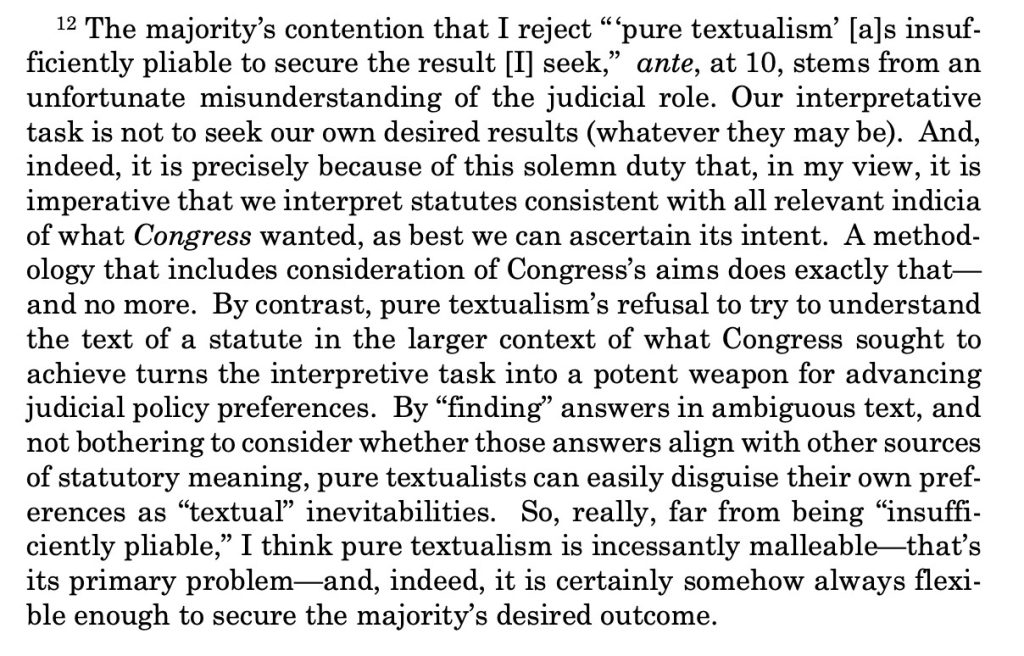
    Commentators today have taken interest in a pointed footnote of Justice Jackson’s dissent in Stanley v. City of Sanford, Florida (p. 23, note 12). I’ve included below a screenshot of the note:

    I find Jackson’s argument here fascinating (and compelling) in light of my recent writing on legal equity, particularly in the concept’s Aristotelian tradition. Above, Jackson criticizes the majority’s embrace of “pure textualism”—that is, the majority’s “refusal to try to understand the text of a statute in the larger context of what Congress sought to achieve.” Such “pure textualism,” in effect, closes off a major method of grappling with the “ambiguous text” of a statute, empowering the Court to “disguise” their own interpretive practices in order to “secure the majority’s desired outcome.” In other words, tossing out any investigation into legislative intent leaves judges with little else to work with aside from their own presuppositions and personal aims, changing linguistic ambiguity from a question for research into a moment to exploit.

    What caught my eye here is how a “refusal to try to understand … what Congress sought to achieve” is a rejection of Aristotle’s approach to legal interpretation in the Nicomachean Ethics. In that text, Aristotle foresees how general laws will need to be applied to unforeseen, particular cases. We will be left, he argues, to “rectify the deficiency [of the law] by reference to what the lawgiver himself would have said if he had been there and, if he had known about the case, would have laid down in law.” (This principle of “rectifying” the law by excavating its intent and bending it around individual cases is what Aristotle calls epieikeia, later translated as aequitas or “equity.”)

    As I lay out in the third chapter of my book, Americans of the 1780s similarly understood how a law’s “consequences were not foreseen by the Legislature” and that, therefore, judges would need to reinterpret laws according to legislative intent (p. 81). In fact, it was understood even in this post-Revolutionary period that attending just to the strict text of the law “resulted in a confusion that wicked men turned to their private advantage” (p. 80). The American Founders and their contemporaries, then, would seem to agree with Justice Jackson. Groveling before the “pure text” of the law and refusing to consider “Congress’s aims” runs against both Greco-Roman attitudes toward statutory ambiguity and an early American embrace of legal equity as a necessary check on judicial corruption.

  • future of the past on learning to be fair

    My department’s “Future of the Past” podcast recently invited me to talk about my new book Learning to Be Fair. It was a good opportunity to bounce around some ideas about civic education, government efforts to regulate discussions of “equity,” and the durable paradoxes surrounding “fairness” that arise from various authors in the Greco-Roman tradition.

    You can find the episode at Apple Podcasts or wherever you get your podcasts, or you can listen in the player below:

  • literature and the legal imaginary

    I’m happy to join a collection of lawyers, historians, and literary theorists in Literature and the Legal Imaginary: Knowing Justice, a new book in the Crossroads of Knowledge in Early Modern Literature series based out of Cambridge University. My own chapter (“The Common Consent of Words: An Aristotelian Element of Hobbesian Legal Rhetoric”) shows how a 1637 summary of Aristotle’s Rhetoric paradoxically draws out some important developments in Hobbes “scientific phase,” during which he reportedly turned away from the rhetorical and humanist texts of his early career and tried to ground his political philosophy in demonstrable proof.